
elsa o’brien lópez
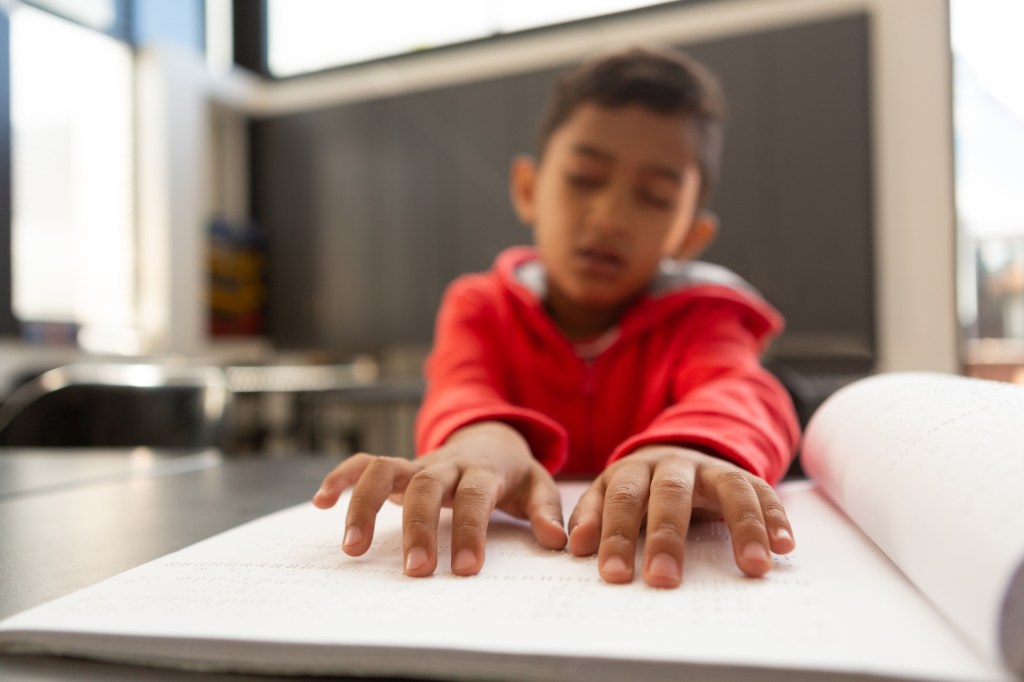
Teaching visually impaired students is not that different from teaching sighted students. However, there are some things that teachers must take into account. One of them is that students will benefit from learning a language in the most natural way possible. Expert Raquel Muñoz Rodríguez speaks about her own experience.
Teachers of English as a second language can often be among the best trained foreign language teachers thanks to all of the high quality qualifications available. There are also myriads of free pedagogically sound resources and continuous professional development.
However, it is possible that even if a teacher has been trained to teach students with special educational needs or disability, they have never had a visually impaired student in their classrooms.
When teaching a visually impaired student face-to-face or online, a teacher will first need to find out the following:
- The degree of the impairment. Is the student completely blind or do they have some residual vision?
- How will they access the class materials? Will they use a zooming or screen reading software and hence need a digital copy of the materials, or will we have to provide a copy of the materials with a big font size. If so, how big?
- If the student is completely blind, it would be useful to know if they have always been or if they became so at some point of their life. If the student lost their vision at an age at which they can still have memories there will be less of a need to explain certain concepts than if they were born blind.
Around eighty percent of learning happens through vision. Teaching English as a foreign language to visually impaired students will prove to be easier for a non-experienced teacher than teaching other content subjects as the students will already know most of the concepts in their mother tongue. For this reason, translation will be a great ally.
We have asked ONCE (National Organisation for the Blind in Spain) English teacher and coordinator, Raquel Muñoz Rodríguez, a few questions to help teachers better meet the needs of their visually impaired students.
What concepts are the most difficult to explain? Could you give us any tips? Can we always rely on translation?
Abstract vocabulary is always the most difficult aspect acquired for visually impaired students. They are non-palpable concepts and this is why students normally need an explanation. In my opinion, translation is always helpful but we need to keep in mind that our objective as teachers is to achieve communicative competence in our lessons. In my classes, I will first use synonyms or any kind of touchable/audible resources related to the abstract concept in order to get the meaning across from different perspectives. If this happens to be too tedious, I will use direct translation.
How can we explain great sizes such as that of a building or a mountain?
This is somehow related to the previous question. Visually impaired students need to understand reality taking their own as a reference. That means, the use of their body and their closest places. For instance, it is useful to explain that a building is 20 times the height of their own body. Another example would be the use of previous knowledge students might have as to how long a metre is. Additionally, models are always a great idea, as well as, the use of their own steps in big spaces.
In your case, most of your students are visually impaired, but it’s a mixed ability group in terms of level of English and impairments. How do you cope with that?
It is always important to make our students part of the learning process and that means explaining that there are different levels as there are different sights. I normally go from general knowledge to more complex or specific depending on their level. But the truth is that every time we start a new unit, for example, they all learn broadly the same content. It is easier for me and more inclusive for them if we are all talking about the same topic even though the levels are not the same. As teachers, the first thing we need to establish are the learning objectives for each student which doesn’t mean the activities need to be different. For example, from a listening task we might want some students to get words related to a specific topic (food) and for others to study how to interact in a restaurant. Both objectives can be met through the same activity.
It’s the same if we think about different visual impairments. Some students will need to work with computer and audio-descriptive programs, some others with Braille or with zoomed written documents. The truth is, all of us learn better if the resources are varied, so, taking this into account, would it be harmful for a student with residual vision to work from a more tactile methodology from time to time? The answer is 100% no! In fact, the learning process would be even more complete.
In your talk in Cervantes Institute you spoke about what learning a foreign language is like for students with a visual impairment. Is it more difficult for them?
Learning, from a general viewpoint, is always more difficult with a visual disability in terms of adaptation and time. Nonetheless, everybody who has learnt a mother tongue can learn foreign languages. The process of learning a first and a foreign language is the same. Our brain can draw on the same learning skills both times.
The only difference would be related to age. Researchers agree that little children learn languages faster during their first years of life thanks to what we call the sensitive periods. Small children rely on innate learning skills to learn their first language. If we teach a language in a natural way, we will allow our students to rely on these innate skills.
Blind students are normally really good at listening tasks as their brain is more focused on finding distinctive sounds than a normative student’s brain so this is something to bear in mind as teachers.
One final question, why is it important for everyone, including visually impaired students to learn foreign languages?
Learning languages makes our brain faster and more organised in terms of choosing vocabulary or finding synonyms and this is something really positive for visually impaired students as one of the most basic principles in their lives is: organisation.
Some final tips for classes with only one visually impaired student in a class of sighted students
Unlike Raquel, most teachers will find themselves teaching only one visually impaired student in a class of sighted students. Very often there will be access to a Braille printer in the school. The teacher might have to be the one adapting the format of the materials and printing them in advance.
In other cases, the student will have residual vision and the teacher will allow the use of a computer or will be in charge of printing them in a larger font. In either case, teachers will have to plan ahead making sure the materials are available in the format the student will need.
As Raquel Muñoz Rodríguez mentioned, using multisensory materials will benefit all of the students in the class and will help include our visually impaired students in the lesson.
MORE LIKE THIS:
-
10 Tips to support dyslexic students during writing tasks
-
Guidelines for marking dyslexic students’ work
-
The dyslexia-friendly language classroom
-
Tips to make reading tasks accessible for students with dyslexia
-
Is it possible to correct language mistakes during project-based learning?
-
Inclusive assessment for the English language classroom
-
Learning languages can benefit neurodivergent learners
-
Challenging gender bias in the classroom
-
How to help develop a child’s language without screens
-
Teaching English to Visually Impaired Students
-
What does an inclusive ESL classroom look like?
-
Teaching English to visually impaired students online
-
5 Easy classroom routines to increase language exposure
-
How project-based learning can make your lessons more inclusive
-
Do men and women speak differently?
-
Special educational needs and second language acquisition
-
How can Universal Design for Learning help with Language Teaching?
Speaker's Digest
Speaker’s Digest wants to make language learning accessible to all regardless of origin, socioeconomic background or learning styles and needs.
Who We Are
Proudly Powered by WordPress
Subscribe for more posts like this
 Speaker's Digest
Leave a comment